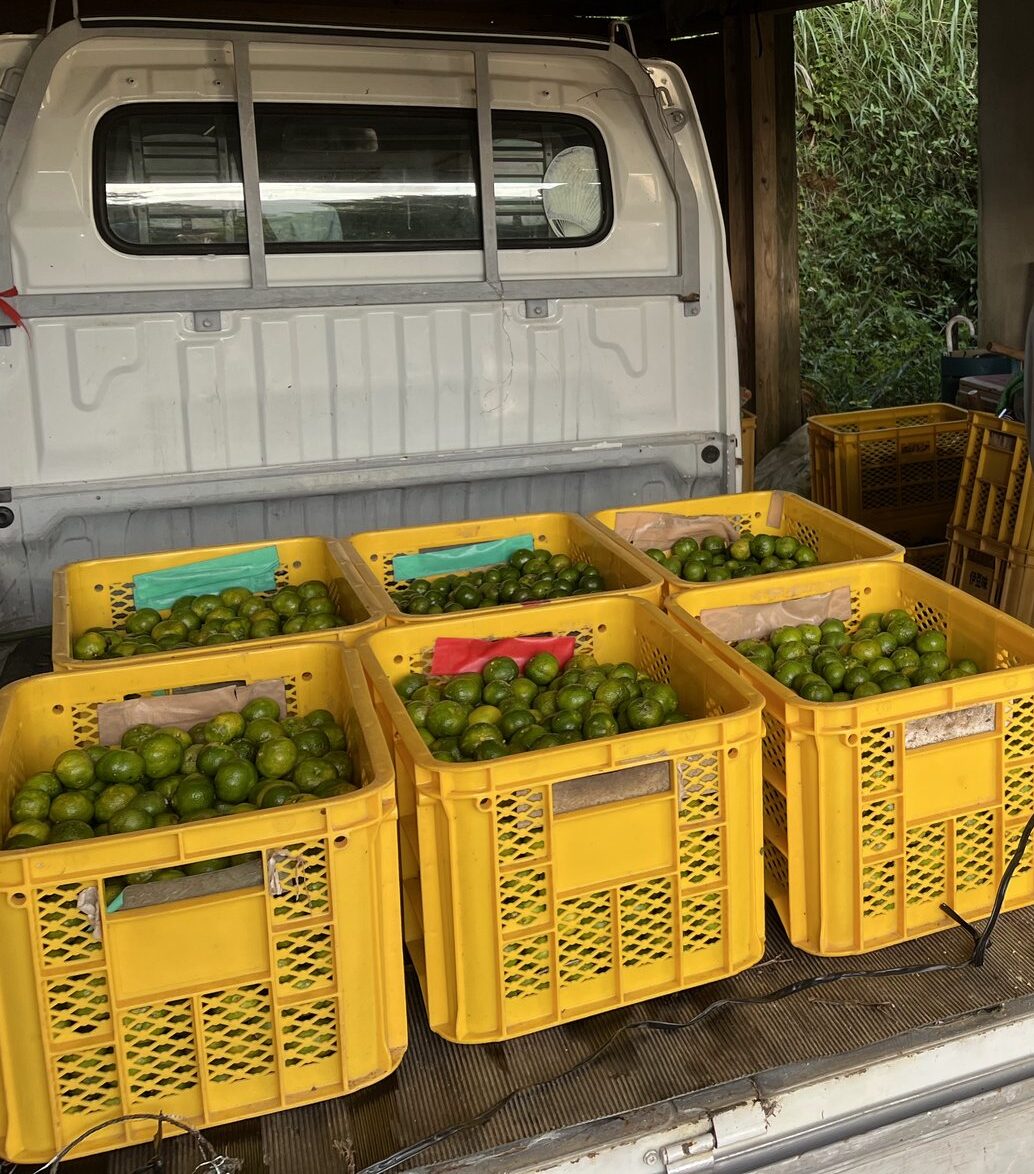
Ask most people to name an Okinawan citrus and they’ll say shikuwasa.
But Izumi — the district where Grandma’s House sits — has grown citrus for generations, and shikuwasa is only part of it. The one that comes into season in autumn is kabuchi.
I don’t have a photo of one yet. I keep eating them before I think to take a picture. I’ll add photos after this year’s trip.
You won’t find it outside Okinawa
Kabuchi is native to Okinawa.
The fruit is small, four to five centimetres across, with a bumpy skin that doesn’t look like much. The thick peel means there’s less fruit inside, so it isn’t an efficient crop. Total production runs at around 60 tonnes a year, and almost all of it is eaten within the prefecture.
Which means it barely leaves the island. To eat one you have to be in Okinawa, in season.
Thick skin, but easy to peel
It’s better than it looks.
The peel is genuinely thick, but peeling one feels no different from peeling a mandarin. If anything it’s easier, because the skin sits loose around the fruit. Your hands don’t end up sticky. The membrane around each segment is slightly thicker than a mandarin’s, though not enough to notice while eating. There were a few seeds.
And it’s sweet.
The smell is like a shikuwasa that has been left to ripen fully — but without the sharpness or bitterness that shikuwasa has. Somewhere between an orange and a shikuwasa is the closest I can get.
It doesn’t taste the way it looks.
Where the name comes from
I asked someone local where the name comes from. “Because the skin is thick,” they said — kaa being skin, buchii being thick.
That’s the whole explanation. It suits the fruit.
The Kabuchi sale, mid-October
Every year in mid-October, over the three-day weekend, Izumi holds what’s called the Kabuchi Festival.
It isn’t a festival in the usual sense — no stalls, no stage. The Izumi citrus growers’ association sets up and sells kabuchi directly.
You can buy kabuchi after the event too, but I’m told the fruit is better and cheaper during it. Worth timing your trip around if you can.
Kabuchi is in season from September through October, peaking in October. The sale lands right in the middle of the best of it.
And after kabuchi
Kabuchi isn’t the only citrus grown here.
Tarugayo follows from late October into late November, and oto from late November into December.
Oto comes from ao-to, meaning green citrus. So I asked what tarugayo means. The answer was: “Who is it?” — as in, not kabuchi, not oto, so who is this one?
I still can’t tell whether I was being told the truth or being teased. Either way, it’s the kind of thing you only hear in a place that grows the stuff.
Through autumn and into winter the varieties change over one by one. Buying a few kinds and tasting them side by side would be a good way to spend an afternoon.
Izumi Mikan no Sato (Izumi Citrus Centre)
2846-3 Izumi, Motobu-cho, Kunigami-gun, Okinawa
Open 9:00–18:00, every day Tel: 0980-47-2889 Parking available
Motobu Tourism Association page
Dates for the Kabuchi sale change from year to year. This year it looks like 10–12 October, but please confirm before going.
Getting there from our houses
It’s a short drive from Grandma’s House — both are in Izumi. About 20 minutes from Uncle’s House.
There are several shikuwasa trees on the grounds at Grandma’s House, and they fruit heavily in autumn. Staying there in season, you get a sense of why this area has grown citrus for so long.

コメント